
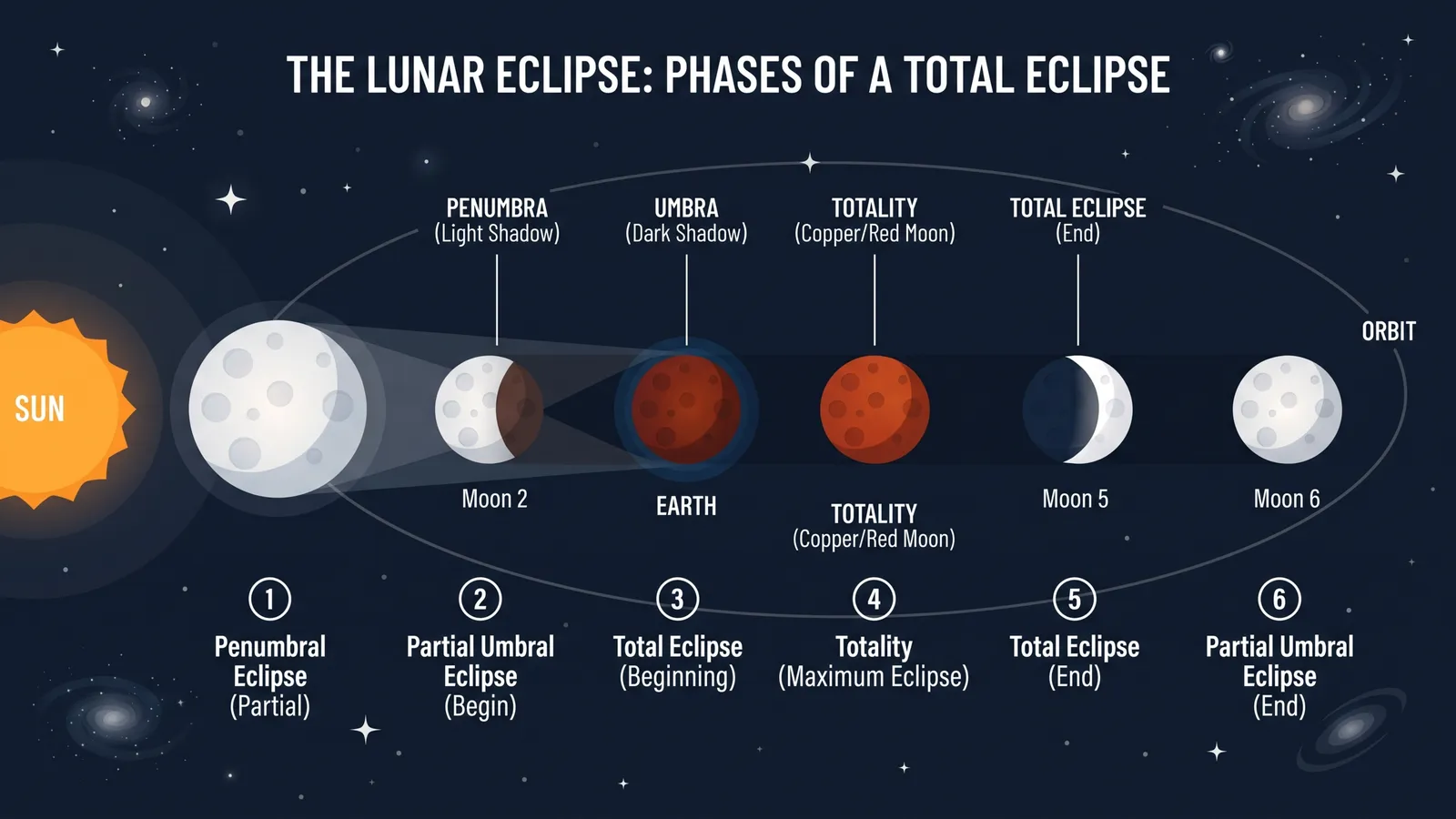
As of October 6, 2026, the solar eclipse 2027 calendar is set for two dates. An annular solar eclipse arrives on February 6, 2027 in Aquarius, followed by a total solar eclipse on August 2, 2027 in Leo. Eclipse 2027 season also brings three lunar eclipses, each one penumbral. This page lays out the confirmed dates, what each type means, and how to read one against your own chart.
When Is the Solar Eclipse 2027?
A solar eclipse happens when the Moon passes between the Sun and Earth, blocking some or all of the Sun’s light as seen from the ground. In 2027 this occurs twice.
The first is an annular solar eclipse on February 6, 2027, landing in the sign of Aquarius. Annular means the Moon does not fully cover the Sun, leaving a visible ring of light around its edge. The second is a total solar eclipse on August 2, 2027, in Leo, where the Moon fully blocks the Sun along its path.
You can verify both passages against an eclipse dates reference built from observational data. Astrologers read the Aquarius eclipse as a prompt around community, ideals, and future planning. The Leo eclipse, by contrast, tends to land on matters of identity, creative output, and who gets to be seen.
What Other Eclipses Happen in 2027?
Three lunar eclipses complete the 2027 eclipse calendar. A lunar eclipse happens when Earth sits between the Sun and Moon, casting a shadow across the lunar surface. All three in 2027 are penumbral, meaning the shadow is the lighter outer portion rather than Earth’s dark core shadow.
| Date | Type | Sign |
|---|---|---|
| February 6, 2027 | Solar, annular | Aquarius |
| February 20, 2027 | Lunar, penumbral | Virgo |
| July 18, 2027 | Lunar, penumbral | Capricorn |
| August 2, 2027 | Solar, total | Leo |
| August 17, 2027 | Lunar, penumbral | Aquarius |
Notice the pattern: the February pair sits across Aquarius and Virgo, the summer pair across Capricorn, Leo, and Aquarius again. Lunar eclipse 2027 events tend to read as emotional culminations, arriving roughly two weeks before or after their solar counterpart.
Why Do Eclipses Cluster in Pairs?
Eclipses occur near the Moon’s lunar nodes, the two points where its orbit crosses the Sun’s apparent path. When a new moon or full moon falls close to a node, an eclipse results instead of an ordinary lunation.
This is why solar and lunar eclipses show up within about two weeks of each other, forming what astrologers call an eclipse season. The 2027 calendar has two such seasons: one in February, one spanning July into August. Outside those windows, new moons and full moons behave as ordinary lunations, a term for the regular monthly new and full moon cycle.
How Should You Read an Eclipse Against Your Own Chart?
An eclipse only becomes personally relevant when it lands near a planet or angle in your natal chart, the fixed map of the sky at your birth. The sign and house it falls in points to the life area under review.
The February 6, 2027 eclipse in Aquarius will touch anyone with planets near early Aquarius degrees, often in the money or partnership houses depending on individual placement. The August 2, 2027 eclipse in Leo does the same for Leo-heavy charts, frequently activating the 10th house of career and public role. This is the kind of layered reading explored further in the progressed chart explained, which tracks how a chart shifts over decades rather than days.
Timing work like this often pairs eclipse dates with longer cycles. Saturn square natal Saturn, which happens around ages 7, 14, 21, 36, 43, and 50, can sharpen what an eclipse brings up by adding a structural pressure point. When both land in the same season, the themes tend to feel more concrete rather than abstract.
Should You Plan Big Decisions Around These Dates?
No astrological date guarantees an outcome, and eclipses are no exception. They mark periods of visibility and change, not verdicts.
If you are weighing a major purchase or contract near these windows, it helps to check what else is active. Mercury turns retrograde from February 10 to March 4, 2027, overlapping the February eclipse season, which can slow paperwork and communication. For decisions like property, the piece on good time to buy a house covers how to weigh timing against practical readiness.
The safer approach treats eclipses as weather rather than fate: useful for noticing what wants attention, not for predicting what must happen. For a fuller spread of 2027 dates alongside these eclipses, the dates section hub collects retrogrades, lunations, and ingresses in one place. You can also read more about the method behind these readings on Vera Solene’s background page, or start from the home page for a wider view of the site’s timing tools.
Eclipses ask you to notice, not to act on command. The 2027 calendar gives five clear points to watch: two solar, three lunar, each tagged with its sign and date. What you do with that window is still yours to decide.
Vera’s readings by email are available if you want a closer look at how these 2027 eclipses fall in your own chart.