 ## How Does a Birthday Chart Differ from Your Natal Chart?
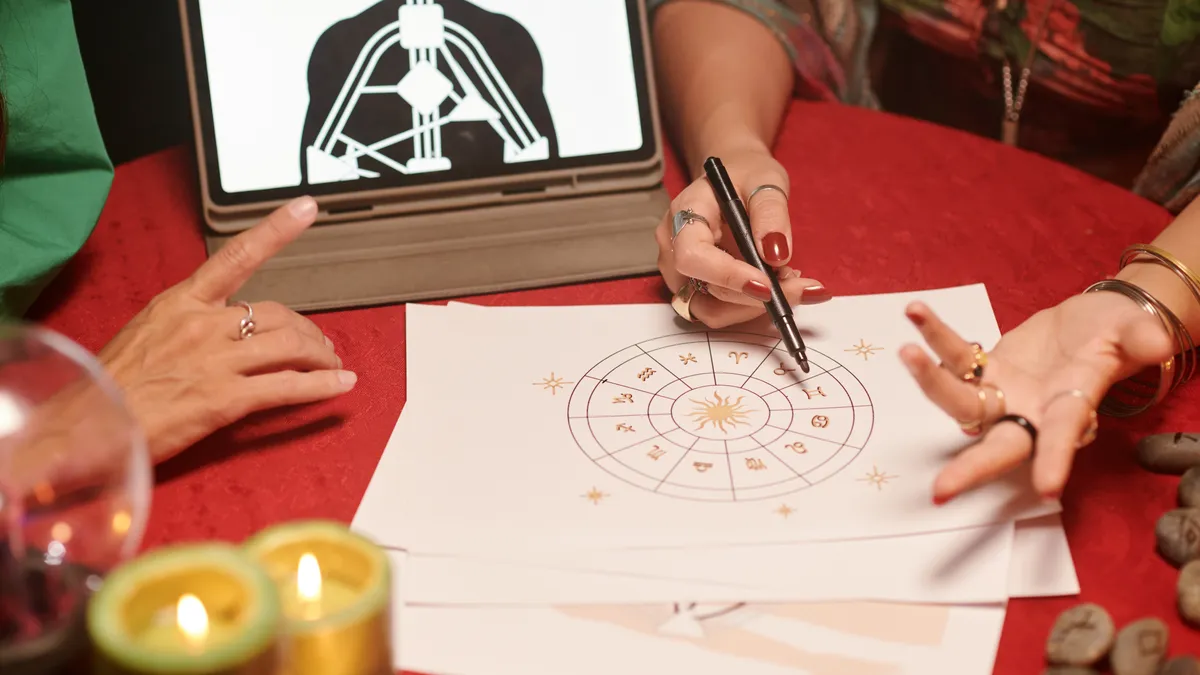
A birthday chart, another name for the annual return chart, only covers the months between one birthday and the next. Your natal chart, by contrast, describes your entire life and never resets. The yearly chart works like a weather report layered on top of that permanent map.
House placements often shift the most between the two charts. A house is one of twelve life divisions in a chart. The 2nd house tracks money and worth, the 4th covers home and family, the 6th shows daily work and health routines, the 7th describes partnership, the 8th shared resources, and the 10th career and public role.
## What Sky Patterns Color Birthday Charts in 2027?
Several retrogrades and eclipses are scheduled across 2027, each tied to specific birthday windows. A retrograde is a period when a planet appears to move backward from Earth's vantage point, often read as a time for review rather than fresh starts. An eclipse marks a stronger lunar or solar event tied to the new or full moon.
These overlaps do not determine outcomes, but they mark periods worth noting if your birthday falls within them. The dates below come from public ephemeris data, the kind of planetary position table published by [NASA JPL's Horizons system](https://ssd.jpl.nasa.gov/), which astrologers and astronomers both use as a source. Five birthday windows in 2027 carry this kind of overlap.
## How Does a Birthday Chart Differ from Your Natal Chart?
A birthday chart, another name for the annual return chart, only covers the months between one birthday and the next. Your natal chart, by contrast, describes your entire life and never resets. The yearly chart works like a weather report layered on top of that permanent map.
House placements often shift the most between the two charts. A house is one of twelve life divisions in a chart. The 2nd house tracks money and worth, the 4th covers home and family, the 6th shows daily work and health routines, the 7th describes partnership, the 8th shared resources, and the 10th career and public role.
## What Sky Patterns Color Birthday Charts in 2027?
Several retrogrades and eclipses are scheduled across 2027, each tied to specific birthday windows. A retrograde is a period when a planet appears to move backward from Earth's vantage point, often read as a time for review rather than fresh starts. An eclipse marks a stronger lunar or solar event tied to the new or full moon.
These overlaps do not determine outcomes, but they mark periods worth noting if your birthday falls within them. The dates below come from public ephemeris data, the kind of planetary position table published by [NASA JPL's Horizons system](https://ssd.jpl.nasa.gov/), which astrologers and astronomers both use as a source. Five birthday windows in 2027 carry this kind of overlap.
| Birthday window | Overlapping event | What it may color |
|---|---|---|
| February 1 to February 20 | Solar eclipse February 6, 2027 in Aquarius; Mercury retrograde February 10 to March 4 | A reset year with extra review around communication |
| June 11 to July 5 | Mercury retrograde in Cancer and Gemini | Home and messaging themes may need double checking |
| July 27 to August 17 | Jupiter enters Virgo; total solar eclipse August 2 in Leo; lunar eclipse August 17 in Aquarius | A visible turning point around identity and daily routine |
| August 10 to December 25 | Saturn retrograde in Aries | Structural review of long-term plans and commitments |
| October 8 to October 29 | Mercury retrograde in Scorpio and Libra | Shared resources and partnership terms may resurface |
 ## How Does the Jupiter Return Fit Into Annual Timing?
A Jupiter return happens roughly every eleven years and nine months, when Jupiter arrives back at its natal degree. This cycle is longer than the yearly birthday chart and tends to mark broader growth chapters rather than single year themes. Reading both charts together can show how a short term year sits inside a longer expansion cycle.
Saturn works on a similar but slower logic. Saturn squares natal Saturn around ages 7, 14, 21, 36, 43, and 50, often felt as a structural check in rather than a crisis. Vera notes that a client's annual chart often sharpens right when Saturn squares natal Saturn, which happens around age 21, since the two cycles land close together.
A first Saturn return lands between ages 27 and 30, a second between 57 and 60. Each one prompts a review of commitments built since the last return. The [progressed chart](/windows/progressed-chart-explained) adds yet another layer, tracking slower inner shifts that a single birthday year cannot show alone.
## Should You Get a Professional Annual Reading?
An annual return reading is one astrologer's interpretation of your personal yearly chart, cast for your birthday location and time. Some people read their own ephemeris data and work through the houses themselves. Others prefer a written walkthrough that connects the chart to broader timing patterns already in motion.
If you already follow eclipse cycles through the [eclipse guide for 2027](/dates/eclipse-2027-guide), an annual reading adds a yearly layer on top of that picture. No reading can promise a specific outcome for the year, since a chart shows timing and themes rather than fixed events. For background on how these interpretations are built, see [Vera Solene's approach to timing](/about/vera-solene).
Vera reads annual charts by email for readers who want a written walkthrough of the year ahead.
## How Does the Jupiter Return Fit Into Annual Timing?
A Jupiter return happens roughly every eleven years and nine months, when Jupiter arrives back at its natal degree. This cycle is longer than the yearly birthday chart and tends to mark broader growth chapters rather than single year themes. Reading both charts together can show how a short term year sits inside a longer expansion cycle.
Saturn works on a similar but slower logic. Saturn squares natal Saturn around ages 7, 14, 21, 36, 43, and 50, often felt as a structural check in rather than a crisis. Vera notes that a client's annual chart often sharpens right when Saturn squares natal Saturn, which happens around age 21, since the two cycles land close together.
A first Saturn return lands between ages 27 and 30, a second between 57 and 60. Each one prompts a review of commitments built since the last return. The [progressed chart](/windows/progressed-chart-explained) adds yet another layer, tracking slower inner shifts that a single birthday year cannot show alone.
## Should You Get a Professional Annual Reading?
An annual return reading is one astrologer's interpretation of your personal yearly chart, cast for your birthday location and time. Some people read their own ephemeris data and work through the houses themselves. Others prefer a written walkthrough that connects the chart to broader timing patterns already in motion.
If you already follow eclipse cycles through the [eclipse guide for 2027](/dates/eclipse-2027-guide), an annual reading adds a yearly layer on top of that picture. No reading can promise a specific outcome for the year, since a chart shows timing and themes rather than fixed events. For background on how these interpretations are built, see [Vera Solene's approach to timing](/about/vera-solene).
Vera reads annual charts by email for readers who want a written walkthrough of the year ahead.